Obtaining a Grant of Probate in South Australia
When a person dies, there are certain requirements that must be fulfilled, for their estate to be finalised.
If the deceased left assets in South Australia, the deceased’s Legal Personal Representative (LPR) - usually the appointed executor in the deceased’s Will, may need to apply to the Probate Registry of the Supreme Court of South Australia to obtain a grant to act as administrator of the deceased’s estate.
In some cases, it may not be necessary to obtain a Grant of Probate, as it depends on the type, size, and value of the assets. For example, if the deceased held assets in their sole name worth less than $50,000 in value. Another example is when real estate assets are held in a joint tenancy. A Grant of Probate is also not required if there is no will, or if there is a will but no appointed executor. In such cases, another type of grant is required called Letters of Administration.
The minimum documentation required to make an application for a Grant of Probate includes:
- The original Will and any codicils (additions that change the Will in some way);
- A true and complete copy of the original death certificate;
- Details of the assets and liabilities of the deceased person as at date of death (including those located interstate or overseas); and
- Payment details for the lodgement fee.
Once probate is granted, it signifies the court’s official recognition that the deceased person’s Will is the most recent version and complies with our laws. It also recognises the executor named in the Will as the LPR of the deceased, whose responsibility it is to finalise the deceased’s estate in accordance with their wishes and the law.
A certified copy of the grant will often be required by financial or other institutions to prove the LPR is authorised by the court to administer the estate. Moreover, without a grant Land Services SA will not process a transfer of the deceased’s sole interest or an interest as a tenant in common, in real estate. A grant will also be required if a third party brings a claim against the estate.
As deceased estate administration is an onerous responsibility which requires an understanding of the law and court procedures; and can potentially lead to personal liability and damages arising from negligence, it is often best left in the hands of a solicitor. Scammell & Co is one of SA’s leading providers of deceased estate services.
For further information about deceased estate administration and the duties of the executor please follow the link here
*This information is current at the time of publication. For accurate legal advice, please contact Scammell & Co on 08 8440 270.
The role of deceased estate executor is an onerous and time-consuming one, but we're here to help.
It is all too likely that you will eventually be nominated as an executor in a Will. You may be aware that you are an executor, but other times you may not. Usually you will find yourself with this responsibility following the death of your spouse, friend or close loved one.
However, what is not often considered is the time-consuming role you may unknowingly inherit once you have accepted your role as executor to an estate. Amongst other things, once you have accepted this role you will take on the responsibilities of administering the estate of the deceased which may include:-
- Locating the last valid Will of the deceased;
- Applying for the deceased’s official Death Certificate;
- Obtaining a Grant of Probate;
- Locating beneficiaries;
- Collecting in all of the assets of the deceased and distributing the same;
- Paying any debts of and fulfilling any outstanding obligations of the deceased;
- Collating and applying for tax returns (and ensuring all tax obligations are dealt with); and
- Dealing with the beneficiaries and acting in your capacity as executor should a third party bring a claim against the estate pursuant to the Inheritance (Family Provision) Act 1972 .
This can be a particularly onerous and time-consuming role, and one which should not be taken lightly.
As an executor, you have a fiduciary duty to administer the estate properly and promptly which brings with that duty various risks including personal liability for making certain decisions and additional liability for various inactions.
Accordingly, it is important that should you become aware that you have been nominated as an executor in a Will or if you have been notified that you are an executor of an estate, then you should know what you are required to do following the death of the testator.
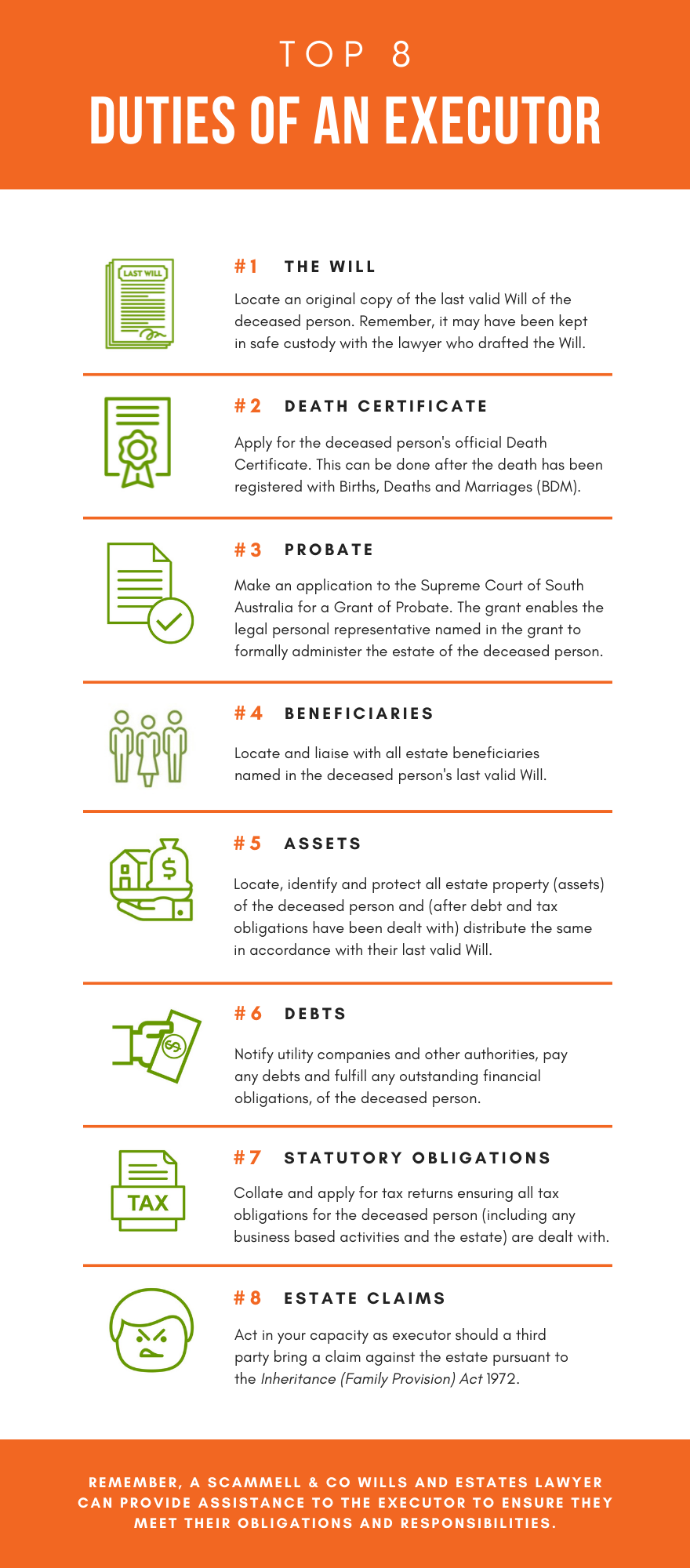
The top 8 duties of a deceased estate executor.
Scammell & Co have highly experienced solicitors to assist in estate administration, probate applications, estate advice and assisting executors to navigate their way through what is usually a difficult and confusing time.
Should you wish to discuss your position or enquire as to how we can help you, please do not hesitate to contact us.
For further information about our deceased estate administration services, please follow the link here
*This information is current at the time of publication. For accurate legal advice, please contact Scammell & Co on 08 8440 270.
How to avoid problems with Executors in the administration of deceased estates
An Executor is the person who administers your estate and ensures that your wishes are upheld after your death. Duties include the collection of the deceased’s assets, payment of outstanding debts, management of the deceased’s tax affairs and distribution of the estate to beneficiaries.
The Executor is usually appointed in your Will. If no executor has been appointed, or if your executor is unable or unwilling to act, another person such as your lawyer can step in to administer the estate. To carry out their duties the Executor will need to apply for a Grant of Probate. This is the Court’s official recognition that the Will is legally valid, and the applicant is authorised to deal with the estate.
It may be beneficial to appoint joint executors (unless your Will is very simple) to share the responsibilities of administering your estate. Also, if one of the appointed persons refuses to accept the responsibility or is no longer alive, the other Executor named in the Will is already in place to carry out their duties. When Executors act jointly, it also minimises the risk of an individual Executor making decisions in their own interest. Nevertheless, a potential problem of having joint Executors is in situations where they do not agree on what is best for the estate. If this is the case the estate can endure delays and incur unnecessary legal fees. So be sure to appoint joint Executors that are likely to cooperate with each other.
The Executor is responsible to preserve, protect and administer the estate diligently. Therefore, if the estate suffers a loss resulting from deliberate or negligent actions on the part of the Executor, this will amount to a breach. If this happens, an action can be taken against them in the Supreme Court and if found liable, the Executor must make good, any loss to the estate.
Types of breaches include:
- Misappropriation or maladministration of assets.
- Breach of trust, or breach in his or her duty of care.
- Failure to observe the provisions or directions in a Will.
- Profiting for themselves whilst acting in their capacity as Executor.
- Making unauthorised investments resulting in a loss to the estate.
- Use of estate assets as a paydown on personal debt.
Given the important considerations when appointing the Executor, it is advisable to speak to a Scammell & Co Wills and Estates lawyer, to minimise potential problems, delays and added expense in the administration of your estate.
For further information about our Deceased Estate Administration services please follow the link here
*This information is current at the time of publication. For accurate legal advice, please contact Scammell & Co on 08 8440 270.