Handwritten Wills are acceptable but may cause unnecessary problems

A Will is a document that sets out how your property is to be distributed when you die. A handwritten Will is adequate for this purpose, however, it is open to interpretation and potential challenges if it is illegible or there are messy edits.

For a Will to be valid it must meet additional criteria in accordance with the Wills Act 1936 (SA). If your Will is deemed invalid, your estate will be distributed in accordance with the rules of intestacy. This may conflict with your wishes.

A valid Will is one that is:

An executor or trustee named in your Will may be a witness, however a beneficiary should not witness the Will.

Alterations should not be made after the Will has been signed, but if necessary, any changes must be initialed by the testator and both witnesses in each other’s presence.

If a Will fails to meet the above requirements, an application can be made to the court to consider its validity. This process may be expensive with no guarantee of success. However, if the court is satisfied that the document expresses the testamentary intentions of the deceased, it can be admitted to probate.

A Scammell & Co lawyer can draft a valid Will on your behalf and advise on the most appropriate Will structure which considers your asset pool and the interests of beneficiaries (including any tax implications).

For further information on our Wills and Estate Planning services follow the l

*This information is current at the time of publication. For accurate legal advice, please contact Scammell & Co on 08 8440 270.
Obtaining a Grant of Probate in South Australia

When a person dies, there are certain requirements that must be fulfilled, for their estate to be finalised.

If the deceased left assets in South Australia, the deceased’s Legal Personal Representative (LPR) - usually the appointed executor in the deceased’s Will, may need to apply to the Probate Registry of the Supreme Court of South Australia to obtain a grant to act as administrator of the deceased’s estate.

In some cases, it may not be necessary to obtain a Grant of Probate, as it depends on the type, size, and value of the assets. For example, if the deceased held assets in their sole name worth less than $50,000 in value. Another example is when real estate assets are held in a joint tenancy. A Grant of Probate is also not required if there is no will, or if there is a will but no appointed executor. In such cases, another type of grant is required called Letters of Administration.

The minimum documentation required to make an application for a Grant of Probate includes:

Once probate is granted, it signifies the court’s official recognition that the deceased person’s Will is the most recent version and complies with our laws. It also recognises the executor named in the Will as the LPR of the deceased, whose responsibility it is to finalise the deceased’s estate in accordance with their wishes and the law.

A certified copy of the grant will often be required by financial or other institutions to prove the LPR is authorised by the court to administer the estate. Moreover, without a grant Land Services SA will not process a transfer of the deceased’s sole interest or an interest as a tenant in common, in real estate. A grant will also be required if a third party brings a claim against the estate.

As deceased estate administration is an onerous responsibility which requires an understanding of the law and court procedures; and can potentially lead to personal liability and damages arising from negligence, it is often best left in the hands of a solicitor. Scammell & Co is one of SA’s leading providers of deceased estate services.

For further information about deceased estate administration and the duties of the executor please follow the link here

*This information is current at the time of publication. For accurate legal advice, please contact Scammell & Co on 08 8440 270.

The role of deceased estate executor is an onerous and time-consuming one, but we're here to help.

It is all too likely that you will eventually be nominated as an executor in a Will. You may be aware that you are an executor, but other times you may not. Usually you will find yourself with this responsibility following the death of your spouse, friend or close loved one.

However, what is not often considered is the time-consuming role you may unknowingly inherit once you have accepted your role as executor to an estate. Amongst other things, once you have accepted this role you will take on the responsibilities of administering the estate of the deceased which may include:-

This can be a particularly onerous and time-consuming role, and one which should not be taken lightly.

As an executor, you have a fiduciary duty to administer the estate properly and promptly which brings with that duty various risks including personal liability for making certain decisions and additional liability for various inactions.

Accordingly, it is important that should you become aware that you have been nominated as an executor in a Will or if you have been notified that you are an executor of an estate, then you should know what you are required to do following the death of the testator.


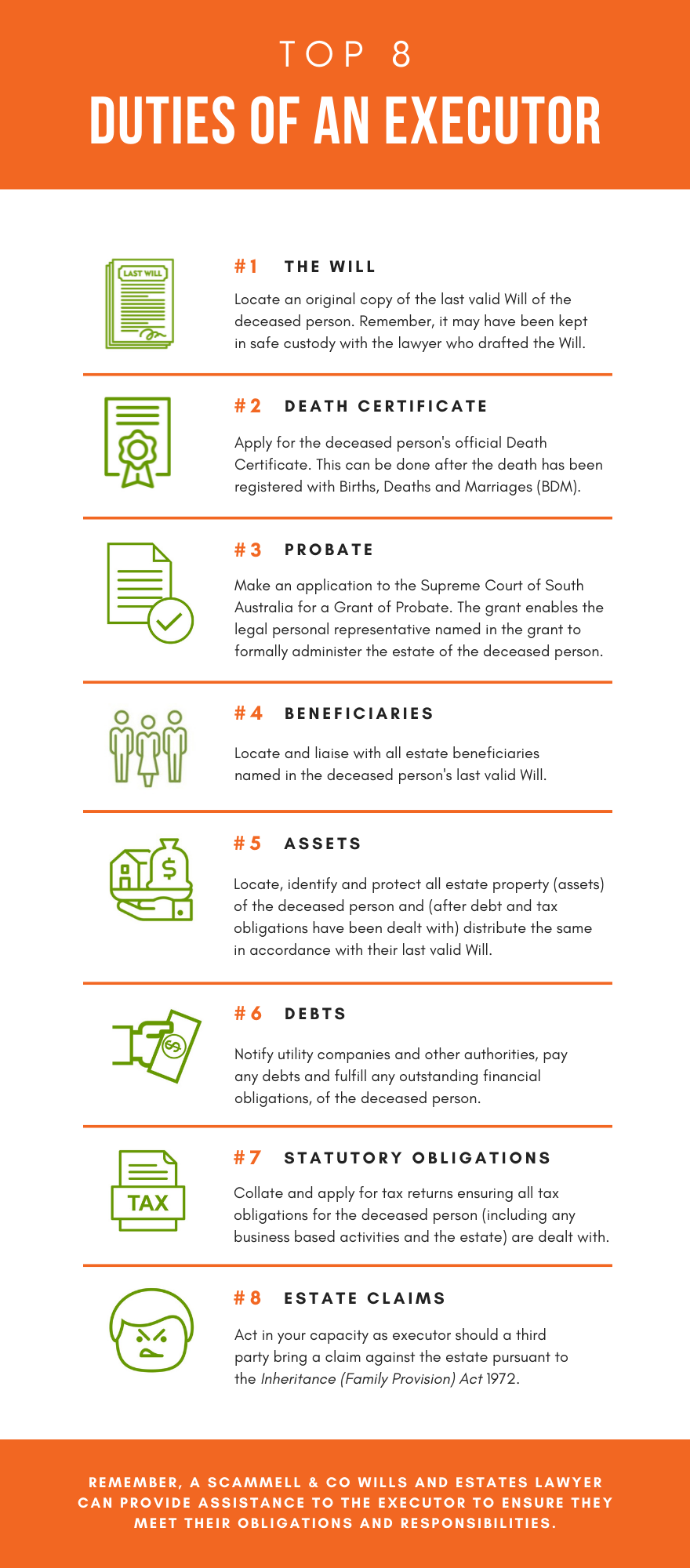
<img src= "duties of an executor (1).png">

The top 8 duties of a deceased estate executor.


Scammell & Co have highly experienced solicitors to assist in estate administration, probate applications, estate advice and assisting executors to navigate their way through what is usually a difficult and confusing time.

Should you wish to discuss your position or enquire as to how we can help you, please do not hesitate to contact us.

For further information about our deceased estate administration services, please follow the link here

*This information is current at the time of publication. For accurate legal advice, please contact Scammell & Co on 08 8440 270.

How to avoid problems with Executors in the administration of deceased estates

An Executor is the person who administers your estate and ensures that your wishes are upheld after your death. Duties include the collection of the deceased’s assets, payment of outstanding debts, management of the deceased’s tax affairs and distribution of the estate to beneficiaries.

The Executor is usually appointed in your Will. If no executor has been appointed, or if your executor is unable or unwilling to act, another person such as your lawyer can step in to administer the estate. To carry out their duties the Executor will need to apply for a Grant of Probate. This is the Court’s official recognition that the Will is legally valid, and the applicant is authorised to deal with the estate.

It may be beneficial to appoint joint executors (unless your Will is very simple) to share the responsibilities of administering your estate. Also, if one of the appointed persons refuses to accept the responsibility or is no longer alive, the other Executor named in the Will is already in place to carry out their duties. When Executors act jointly, it also minimises the risk of an individual Executor making decisions in their own interest. Nevertheless, a potential problem of having joint Executors is in situations where they do not agree on what is best for the estate. If this is the case the estate can endure delays and incur unnecessary legal fees. So be sure to appoint joint Executors that are likely to cooperate with each other.

The Executor is responsible to preserve, protect and administer the estate diligently. Therefore, if the estate suffers a loss resulting from deliberate or negligent actions on the part of the Executor, this will amount to a breach. If this happens, an action can be taken against them in the Supreme Court and if found liable, the Executor must make good, any loss to the estate.

Types of breaches include:

Given the important considerations when appointing the Executor, it is advisable to speak to a Scammell & Co Wills and Estates lawyer, to minimise potential problems, delays and added expense in the administration of your estate.

For further information about our Deceased Estate Administration services please follow the link here

*This information is current at the time of publication. For accurate legal advice, please contact Scammell & Co on 08 8440 270.

Common questions about Wills and other estate planning documents answered

Wills are legal documents that name the people you want to receive property, possessions and assets that you own at the date of your death – these people are known as your beneficiaries. Wills are the only way you can ensure your assets are distributed in the way you intended after you pass away. Therefore, Wills are essential if you are concerned about who will receive your assets and it is particularly important if you have a family, or other dependants.

What are valid Wills?

Wills are only valid and accepted by the court if they are in writing and signed and dated (preferably every page) by the testator (the person making the Will) in the presence of two independent witnesses (aged 18 years or over). The witnesses must also be named on the Will and co-sign and date the Will in the presence of each other and the testator. To avoid a conflict of interest, a witness should not be a beneficiary to the Will. Only then is a Will put into full effect by a grant of probate. If a Will is not drafted and duly executed properly it may be set aside and your property distributed according to the rules of intestacy (the condition of your estate if you do not have a valid Will), which may conflict with your wishes.

Another important consideration for anyone wanting a Will is that it should be drafted and signed by someone of sound mind, memory and understanding – without any undue influence from other people.

Once a Wills is complete it should not be added to, deleted from, pinned, stapled or even have a paper clip attached. It is highly recommended that an experienced Wills and Estate Planning lawyer be consulted if an intended change is to be made to a Will because even the simplest change must be correctly done or it may have adverse results – potentially invalidating the Will.

Should I update my existing Will?

A Will should reflect your current wishes and circumstances. As a guide you should review your Will every few years. Changes to your circumstances can include events such as marriage, separation or divorce; you may have become a parent or grandparent; bought or sold assets; your financial situation may have changed significantly; you may have retired; or either a beneficiary or your appointed Executor may have died.

What is Probate & how does it work?

Probate is the legal process to validate the Wills of deceased persons to fulfil their wishes that are to be carried out by the Executor named in the Will. If awarded, a Grant of Probate is the court’s official recognition of the validity of a Will and who the Executor of Will is.

Probate may be required when a person has passed away and leaves behind certain kinds of assets. For example, if there is a large sum of money in a bank account and the deceased was the sole account holder, a Grant of Probate may be requested by the financial institution in order for the Executor to access the account.

What are the duties of the Executor?

An Executor is someone nominated in a person’s Will whose responsibility it is to administer the deceased’s estate. Many testators elect a friend or close relative to be the Executor of their Will. This nomination is typically regarded as a mark of respect and reflects a high degree of trust which the testator has in their abilities. However, the Executor’s duties are onerous and can be very time-consuming and often requires professional advice and assistance. If you have been appointed an Executor, you should seek-out the efficient services of a lawyer experienced in the administration of deceased estates.

What is a Power of Attorney?

A Power of Attorney is an important document that allows you to appoint one or more people to make decisions concerning your legal and financial matters while you are alive. A Power of Attorney ceases upon your death, at which time your Will comes into effect.

There are two types of Power of Attorney to consider:

A General Power of Attorney is an authority given to someone to deal with your financial and legal affairs on your behalf from the time you execute the document. For example, it allows you to appoint someone to sell your house while you may be overseas, invest your money or operate your bank accounts.

An Enduring Power of Attorney operates when you become legally incapacitated. For example, if you have lost mental capacity due to a stroke, dementia or brain injury. Both can be combined into a General and Enduring Power of Attorney should you wish to appoint someone now to act on your behalf and continue to act should you lose mental capacity.

While a Power of Attorney deals with your financial and legal issues, it does not cover personal aspects of your life such as health care, accommodation or lifestyle issues. These are covered by an Advance Care Directive.

What is an Advance Care Directive?

Advance Care Directives have replaced Enduring Powers of Guardianship, Medical Powers of Attorney and Anticipatory Directions. While your Enduring Power of Guardianship may still be valid, an Advance Care Directive allows you to set out in detail your wishes regarding future healthcare and lifestyle decisions, such as preferred living arrangements. It also enables you to set out legally binding refusals of healthcare.

An Advance Care Directive enables you to appoint someone (often your loved one) as your Substitute Decision Maker to make these decisions on your behalf when you are unable to make them yourself. Therefore, being able to make legally binding decisions now regarding your healthcare enables you to provide instructions for your loved ones to follow in what often is a traumatic and emotional time for them.

You may for example, include in your Advance Care Directive, to not be kept alive on life support or to be resuscitated in certain circumstances. Should this occur, these directions are then followed through by your Substitute Decision Maker, giving both yourself and them peace of mind.  It may also reduce the possibility of conflict between family members as you have appointed a particular person to carry out your wishes.

Scammell & Co is one of South Australia’s leading providers of Wills & Estates services. We have established an enviable reputation for quality and thoroughness. No matter how simple or complex your estate planning needs are, our lawyers have the expertise to provide customised Wills and Estate Planning documents. Call our team today on (08) 8447 4466 or contact us via the enquiry form to discuss how we can assist you.

*This information is current at the time of publication. For accurate legal advice, please contact Scammell & Co on 08 8440 270.

Obtaining a Grant of Probate for the administration of a deceased estate explained

When a loved one dies their estate needs to be attended to. Locating the deceased person’s Will and obtaining a Grant of Probate is the first step in this process. The appointed executor of the Will is required to make an application in the Supreme Court for the Grant. A Grant of Probate is a certificate from the Court verifying that the deceased left a valid Will and that the Executor is entitled to administer the estate.

Generally, a Grant of Probate application includes:

The original Will is lodged at the Court where it remains permanently.

Not every estate will require a Grant of Probate before being able to be administered. For example, estates with low value assets can usually be dealt with informally. A Grant is also not required in instances where all assets are held by the deceased jointly with another person(s) who has survived.  However, a formal Grant is required in instances where a third party such as Land Services SA, nursing homes, banks and company share registries stipulate the need for a Grant to release an asset. A Grant may also need to be obtained in instances where the estate could be contested by an eligible applicant under the Inheritance (Family Provision) Act 1972.

The time it takes to obtain a Grant depends on the complexity of the estate. For example, it can take several months to identify all the assets and liabilities. Once an application has been filed with the Court it can take between one to two months (longer if the court is busy) for the court to review it and issue the Grant. The speed of this process also depends on whether or not the court requires further information from the executor.

Making an application for a Grant is often a complex and onerous process. Moreover, it requires an understanding of the technical aspects of the law and an appreciation of court procedures. A Scammell & Co. solicitor has the skills and experience to apply for a Grant and administer a deceased estate on behalf of executors.

More information on Wills and Deceased Estate Administration can be found here.

*This information is current at the time of publication. For accurate legal advice, please contact Scammell & Co on 08 8440 270.