When it comes to resolving neighbour disputes over trees, it helps to know your rights and responsibilities
Trees are a common cause of disagreements between neighbours. Disputes can arise over tree size, overhanging or fallen branches, shade, invasive root systems and the potential for a tree to cause injury or damage. The rights and responsibilities of tree owners and affected neighbours are covered by the common law of nuisance.
To establish that the tree owner is legally responsible, an affected neighbour must first prove that a tree (or trees) is the problem. This is straightforward if the issue is visible but difficult to prove if root damage is alleged.
If the tree and its root system is entirely on the owner’s side of the boundary then there is no liability. Moreover, there is no liability for shading, unsightliness, or the blocking of a view by a tree which is entirely on another person’s land. If a strong, healthy tree blows down in a storm, this is considered an ‘act of god’ for which there is no liability. Also, trees defined as ‘regulated’ or ‘significant’ cannot be touched without a court order.
Negligence on the part of the tree owner may be proved if the affected neighbour’s property sustained loss or damage due to the owner’s failure to take adequate precautions. In this case compensation would usually be sought by the affected neighbour. Also, if the tree owner cuts off branches or gathers leaves and discards them over the boundary, the affected neighbour may bring an action for trespass.
Where a nuisance situation is found to exist, the law may provide several remedies, depending on whether actual damage or loss has occurred, or is likely to occur. In most cases the main legal remedy for encroaching roots or branches is the right to cut them off at the boundary. However, this would usually be at the cost of the affected neighbour. If a tree owner is unwilling to pay for loss or damage the affected neighbour may apply for a court order.
Scammell & Co can provide advice and assist clients in resolving such disputes between neighbours. Contact us for a FREE intitial discussion.
For information on the civil litigation (dispute resolution) process please follow the link here.
*This information is current at the time of publication. For accurate legal advice, please contact Scammell & Co on 08 8440 270.
Adelaide residents and businesses negotiate over final stages of North-South Corridor project
The State and Federal Governments have jointly announced the long-awaited decision on the preferred option for the final 10.5km River Torrens to Darlington section of the North-South Corridor upgrade.
The decision has been contingent on a comprehensive analysis of the traffic, ground conditions, local environment, heritage assets and community and stakeholder feedback.
Whilst the North-South Corridor project is touted as South Australia’s biggest ever job-creating infrastructure project, the impact on the many residents and businesses effected by the planning and construction stages is immense.
On the table have been three design options: an at-surface motorway; twin underground tunnels; or a hybrid of the two. A two-tunnel ‘Hybrid+’ option has been given the green light. What this means is that the initial 900-odd homes and businesses earmarked for compulsory acquisition to make way for the open motorway option, will now be reduced to around 400 properties. The 'Hybrid+' option will also protect iconic community and heritage assets including the Thebarton Theatre, Hindmarsh Cemetery, Hoffman Brick Kiln and Queen of Angels Church.
The $8.9 billion project will be delivered in two stages over the next ten years. Stage One consists of a 6km stretch of motorway including more than 4kms of tunnels between Anzac Highway and Darlington. Stage Two consists of the remaining 6km stretch which includes an at-surface motorway and northern tunnel connecting the River Torrens to Anzac Highway.
Under the Land Acquisition Act 1969 (SA) an Authority such as the State Government can acquire or gain temporary access to your property for road construction or utilities work.
Initial negotiations for compensation will take place between the Authority and affected stakeholders which can include a property owner, a lessee (a tenant), an executor of a deceased estate, a mortgagee, a business operator and a native title claimant or holder. If an agreement is reached, the matter will proceed to settlement.
If an agreement is not reached, a property can be acquired by compulsory means under the Land Acquisition Act 1969 (SA).
Compensation is based on fair market value of the property to be acquired. Other factors considered when determining compensation may include any loss to the remaining land caused by partial acquisition; any loss due to disturbance; and special value, including any business based issues. Reasonable costs such as valuation fees, legal expenses and conveyancing related to the acquisition should also be reimbursed.
If affected parties object to the purchase, there are established procedures for appeal to the Courts, which may include an objection or alteration to the acquisition. This review may or may not be successful.
If an interested party believes the Authority’s offer is unfair then they should seek independent legal advice. An experienced Scammell & Co. property lawyer can explain your rights and get the compensation you are entitled to.
For further information on Scammell & Co.'s Compulsory Acquisition services please follow this link: https://scammell.com.au/areas-of-law/compulsory-acquisition/
For advice and/or representation in your particular matter please contact our experienced property lawyers.
*This information is current at the time of publication. For accurate legal advice, please contact Scammell & Co on 08 8440 270.
Changes to South Australia's Land Tax regime is imminent
The South Australian government has introduced new land tax changes which are set to take effect from midnight 30 June 2020. Given South Australia has the highest land tax rate in Australia the reforms are aimed at making the land tax system fairer and make South Australia a more competitive place to do business. The government claims that 90% of taxpayers – including “mum and dad” investors will be better off. The new provisions are complex and property owners should do their research and seek professional advice to ensure they don’t end up paying more tax than is necessary. Any changes must be made prior to the end of the financial year as land tax is calculated on holdings that exist as at 1 July in each financial year.
The measures will see the introduction of new rates and new methods of calculation. Key points:
- If your land is already exempt from land tax, the exemption will continue. For example, if it relates to primary production or the residence is your principal place of residence.
- If you only own one taxable property there are no changes to how your land tax is assessed. You may receive a reduction in land tax payable due to the tax-free threshold increasing to $450,000 and rate reductions – for example the top rate of land tax will drop from 3.7% to 2.4%. The same applies if you own multiple taxable properties (that are all owned by the same owner(s), as long as the combined taxable site value does not exceed the new threshold.
- A key change to the way land tax is calculated is that the property ownership on behalf of each person will now be aggregated. For example, if you own a share in multiple properties, your land tax will be calculated based on the total value of your personal holdings.
- Trusts will be subject to a 0.5% surcharge where the trust owns property with a site value exceeding $25,000. A default tax rate applies to trusts where an individual beneficiary is not declared. They will not be entitled to the new tax-free threshold of $450,000, however, the surcharge will not apply to charitable trusts or superannuation trusts. There are also special rules for the holders in fixed and unit trusts. Trustees will also be subject to extensive notification requirements.
- Special rules apply for land held by corporations. Corporations can be grouped and assessed as a single entity if they have the same controlling persons or where one company is able to cast 50% or more of the votes in the second company, or it owns half or more of the shares.
- Concessions by way of a $25 million transition relief fund are available for certain taxpayers
- Developers may also qualify for concessions in certain circumstances.
Scammell & Co. can assist individuals and businesses by providing legal advice relating to estate matters such as trust structures and tax obligations for beneficiaries, as well as assistance in company law and property law matters.
For further information on the new land tax reforms please refer to the RevenueSA website.
*This information is current at the time of publication. For accurate legal advice, please contact Scammell & Co on 08 8440 270.
Impacted by an Adelaide infrastructure project? Get fair compensation.
Scammell & Co are assisting Adelaide property owners and businesses who find themselves at a stalemate with the DPTI over compensation
The Government of South Australia has announced $12.9 billion worth of infrastructure spending on major projects across the state over the next four years. Such projects are crucial in meeting the future needs of the state’s growing population, providing economic stimulus - including much needed job opportunities during the planning and construction phases and ultimately making the city’s roads safer and more efficient for all users. Unfortunately, they also come at a cost to existing property owners and businesses - forced to make way for such projects.
Current projects either in the planning or construction stage include:
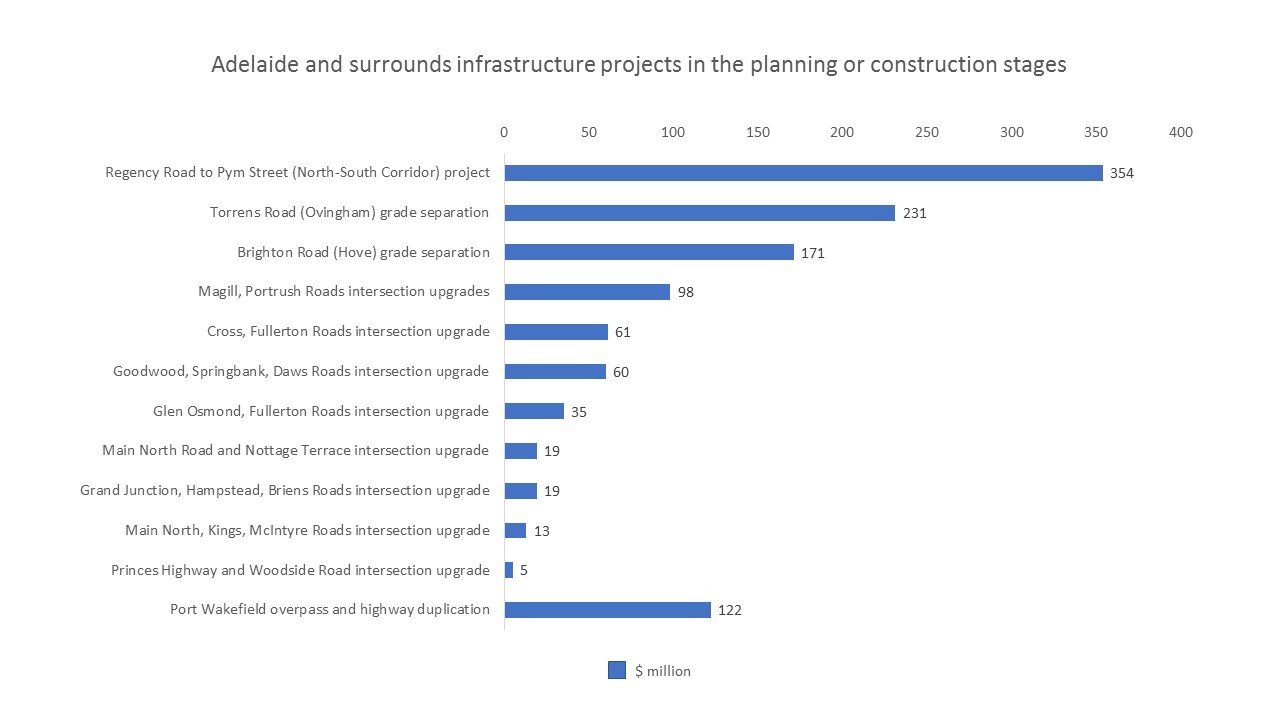
From the list above, two examples of road projects causing significant stress and anxiety for property owners and businesses include:
- the Portrush and Magill Roads intersection upgrade – with up to 47 existing homes, units and commercial buildings slated for demolition or partial acquisition; and
- the Princes Highway and Woodside Road intersection upgrade – with 9 properties subject to whole or partial acquisition.
Some of the residents and business owners affected by these projects claim that up until now there has been poor communication from the Department of Planning, Transport and Infrastructure (DPTI) - with little to no community consultation. Issues around the loss of local amenity and the fact that there has been a disregard for buildings or other structures of historical significance is adding to people’s concerns over the projects. Furthermore, those affected claim negotiations currently underway regarding financial compensation have been woefully inadequate.

Government SA - Department of Planning, Transport & Infrastructure draft proposal - Portrush and Magill Roads intersection upgrade.
Compensation is based on fair market value of the property to be acquired. Other factors considered when determining compensation may include any loss to the remaining land caused by partial acquisition; any loss due to disturbance; and special value including any business based issues. Reasonable costs such as valuation fees, legal expenses and conveyancing related to the acquisition should also be reimbursed.
If affected parties object to the purchase, there are established procedures for appeal to the Courts, which may include an objection or alteration to the acquisition. This review may or may not be successful.
Scammell & Co. Solicitors are one of South Australia’s leading property law firms and have extensive experience in property acquisitions. We provide independent legal advice to ensure the rights of property owners, businesses and tenants are not diminished, and they get the compensation they are entitled to.
If you would like to discuss your unique circumstances, please contact us today for a confidential and obligation-free initial consultation on (08) 84474466.
For further information please visit our Compulsory Acquisitions page.
*This information is current at the time of publication. For accurate legal advice, please contact Scammell & Co on 08 8440 270.
Joint Tenants vs. Tenants in Common explained
When two or more people purchase property together there are two options available to them in how they wish to hold the property.
The most common form of ownership amongst couples is Joint Tenants. This means that when one person dies the property will automatically pass to the surviving registered owner under the rule of survivorship.
The other option is Tenants in Common which means each person owns a portion or percentage in the property. This is more commonly used in the purchase of an investment property. In the event one person dies their portion forms part of their estate and is dealt with in accordance with their Will or in the absence of a Will, under the laws of intestacy.
Seeking legal advice will ensure you are informed of potential issues. For example, in the case of Joint Tenants, if you have children from a previous relationship and you die, the property will pass to your partner. Your partner could then update their Will to exclude your children from inheriting, and unless they are dependent on your partner they are unlikely to have a claim against your partner’s estate.
*This information is current at the time of publication. For accurate legal advice, please contact Scammell & Co on 08 8440 270.